Explore key cognitive development milestones from birth to age six. Learn about Piaget’s stages, activities to support growth, and signs of cognitive delays.
What is cognitive development in early childhood?
Cognitive development is how a child's mind grows and changes as they interact with the world around them. It includes the continuous progression of thinking, reasoning, problem-solving, and decision-making skills.
As children develop, their expanding cognition links closely to other developmental domains like language and social-emotional skills. Understanding these milestones helps educators and families support children effectively in any childcare program.
What are cognitive development milestones?
Cognitive development milestones are specific skills and achievements that mark a child's progress in thinking, learning, and understanding the world. These milestones include abilities ranging from recognizing a familiar face in infancy to thinking abstractly and solving complex problems in childhood.
Cognitive development is one of four significant developmental domains, along with physical, social-emotional, and language development. It involves:
- Processing information: Learning to walk, talk, and read.
- Abstract thinking: Understanding concepts like love, empathy, or fairness.
- Categorization: Grouping items logically, such as associating a dog with the "animal" category.

Activities Across Developmental Domains
A free guide with activity ideas that foster child development across developmental domains.
How do children progress through the milestones? (Piaget's stages)
Children move through four specific stages of cognitive development as they grow, beginning in infancy and evolving into adulthood. Psychologist Jean Piaget identified these four distinct stages of cognitive development to explain how children learn.
Sensorimotor stage (birth to age 2)
In this first stage, infants learn about their environment through sensory information—touch, sound, sight, and taste. Children experiment with objects to understand reactions, such as shaking a rattle to hear a noise.
The primary goal of this stage is developing object permanence, the understanding that things continue to exist even when they cannot be seen.
Preoperational stage (ages 2 to 7)
Children in this stage begin to think symbolically and abstractly. They can use their imagination to understand that an object exists without seeing it, which makes games like hide-and-seek possible. Key characteristics include:
- Make-believe play: Engaging in imaginative scenarios.
- Intuitive thinking: Relying on perception rather than strict logic.
- Developing conservation: Beginning to grasp (though often struggling with) the concept that quantity remains the same despite changes in shape or container size.
Concrete operational stage (ages 7 to 11)
During this stage, logical thinking and concrete reasoning emerge. Children learn to:
- See perspectives other than their own.
- Classify objects and arrange items in sequence (e.g., organizing from tallest to shortest).
- Apply logic to physical objects, though abstract or hypothetical concepts remain difficult.
Formal operational stage (age 12 and up)
In this final stage, children develop the ability to think logically about abstract ideas. They can formulate various solutions to hypothetical problems and think scientifically about the world.
Why is cognitive development important?
Cognitive development serves as the foundation for academic success and lifelong learning. It involves taking in, processing, storing, and applying information to everyday life.
Since young children’s brains act like sponges, early stimulation is critical. When families and educators foster cognitive skills from birth, they build the neural connections necessary for children to process and retain information effectively later in life.
Cognitive development milestones by age group
Every child develops at their own pace, but tracking milestones helps educators and families identify if a child is on track. Below is a breakdown of skills typically observed at specific ages.
|
Age |
Milestones |
|
0 to 3 months |
|
|
3 to 6 months |
|
|
6 to 9 months |
|
|
9 to 12 months |
|
|
12 to 18 months |
|
|
18 months to 2 years old |
|
|
2 to 3 years old |
|
|
3 to 4 years old |
|
|
4 to 5 years old |
|
|
5 to 6 years old |
|
Classroom support strategies for early childhood educators
Early childhood educators can support cognitive development by creating environments that encourage exploration, problem-solving, and curiosity. Implementing structured, intentional strategies in your childcare program helps children build critical thinking skills.
- Ask open-ended questions: Encourage children to think deeply by asking questions like, "What do you think will happen next?" instead of yes or no questions.
- Rotate learning centers: Frequently update your classroom materials to keep children engaged and introduce new cognitive challenges.
- Follow the child's lead: Observe what interests the children and build lesson plans around those topics to naturally encourage their focus and motivation.
- Scaffold learning: Provide just enough support so a child can learn a new skill independently, then step back as they master it.
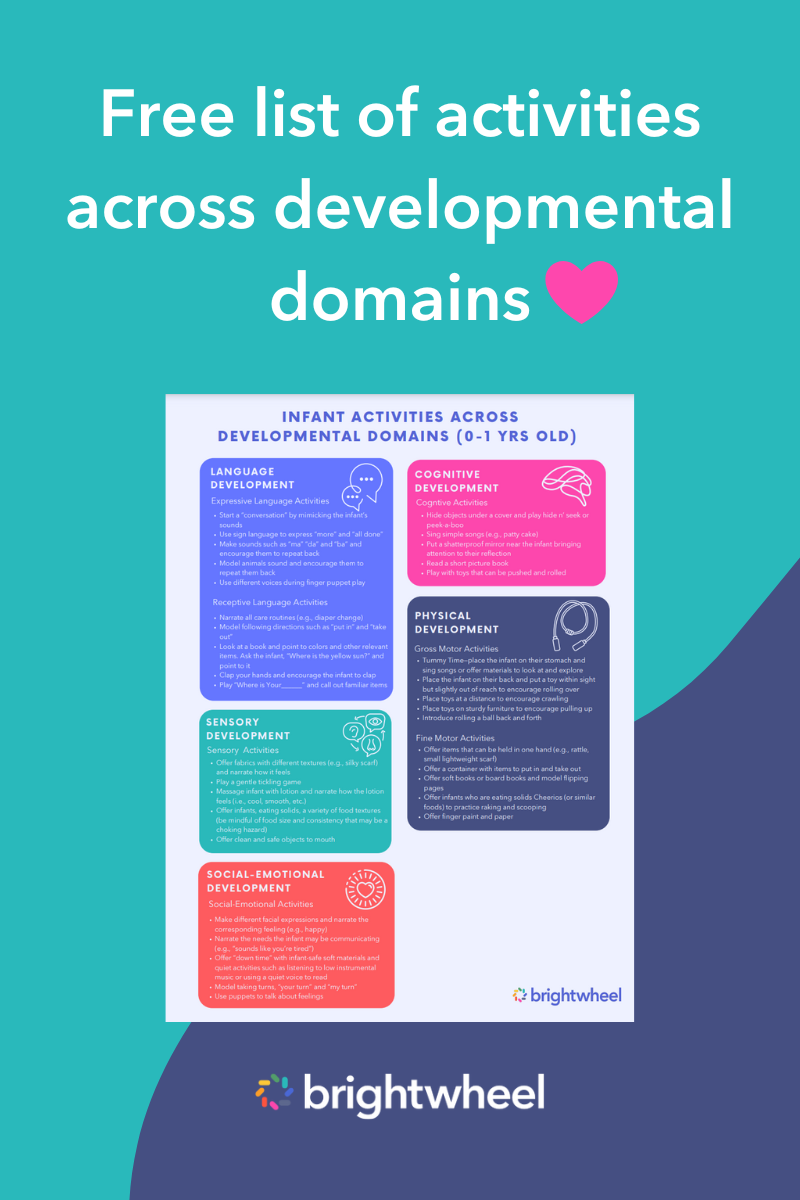
Activities Across Developmental Domains
A free guide with activity ideas that foster child development across developmental domains.
Activities to promote cognitive development
Families and educators can strengthen cognitive skills through targeted interaction and play. Here are effective activities for different age groups.
Infants
- Reading: Helps infants recognize voices and sounds, building language and listening skills.
- Singing: Introduces new words and rhythms to aid memory and language.
- Exploratory play: Provide safe boxes, spoons, or interactive toys with buttons to teach cause and effect.
- Hiding objects: Play peek-a-boo or hide toys under blankets (around 7–8 months) to reinforce object permanence.
Toddlers
- Music and movement: Singing and dancing boosts memory and coordination.
- Animal sounds: Mimicking sounds helps toddlers associate sounds with specific animals/images.
- Flashcards: Use cards to identify colors, numbers, and animals. Ask questions like, "Where is the blue car?" to test recognition.
- Pretend play: Provide props like kitchen sets or dress-up clothes to stimulate imagination.
Preschoolers
- One-to-one correspondence: Activities that involve counting objects one by one to build early math skills.
- Memory games: Matching games improve concentration and pattern recognition.
- Board games: Games like Chutes and Ladders teach counting, turn-taking, and following rules.
- Name exploration: Puzzles or writing activities using their name improve literacy and fine motor skills.
Signs of cognitive delays and when to seek professional help
While variation in development is normal, recognizing potential delays early is crucial for effective intervention. Genetic conditions, health issues, or environmental factors can all contribute to delays.
Common signs of cognitive delays include:
- Significant delays in sitting, crawling, or walking.
- Difficulty speaking or not saying words by expected ages.
- Trouble understanding social rules or consequences.
- Inability to solve simple problems (e.g., puzzles).
- Short attention span or inability to recall information.
- Lack of age-appropriate self-help skills.
If you suspect a delay, encourage the family to consult a pediatrician immediately. Early intervention programs can provide comprehensive assessments and necessary support.
Conclusion
Cognitive development is essential to a child’s growth and overall learning. When a child has healthy cognitive development early on, they’re more likely to succeed later in life. Educators and families play an important role in fostering a child’s cognitive skills through incorporating developmentally appropriate activities, tracking key milestones, and acting early if there are any concerns.
Frequently asked questions
Q: What is cognitive development in early childhood?
A: Cognitive development in early childhood is the process by which a child learns to think, reason, solve problems, and understand the world. It involves taking in information, developing memory, and building the neural connections necessary for lifelong learning.
Q: What activities support cognitive development?
A: Activities that support cognitive development include reading, singing, memory games, and pretend play. Educators and families can also use puzzles, sorting games, and open-ended questions to encourage critical thinking in young children.
Q: What is the difference between cognitive and social-emotional development?
A: Cognitive development focuses on how a child thinks, processes information, and solves problems. Social-emotional development focuses on a child's ability to understand feelings, interact with others, and manage their emotions.
Q: Can cognitive delays be reversed?
A: With early intervention and consistent support, many children can make significant progress and overcome delays. The earlier a child receives help, such as therapy or specialized education, the better the long-term outcomes.
Q: How does nutrition affect cognitive development?
A: Proper nutrition provides the fuel the brain needs to grow and function. Deficiencies in essential nutrients, like iron or healthy fats, during early childhood can negatively impact focus, memory, and overall learning potential.