A preschool assessment is an evaluation tool early educators use to track a child’s developmental progress and measure curriculum effectiveness. Most preschool assessments are short observations of 10 to 15 minutes, run three times a year, that record each skill as “present,” “emerging,” or “not yet emerging.” They are observations, not pass-fail tests, and children do not study for them.
Every child is unique, showing individual personalities, preferences, and skills from the moment they are born. Families, educators, and caregivers must track a child’s development to ensure they meet physical, emotional, and cognitive benchmarks. Since observing daily progress can be difficult, regular early childhood assessments provide vital information on whether a child is hitting the right developmental milestones.
In this article, we cover everything you need to know about preschool assessments, including their benefits, how to administer them, and templates to use in your childcare program.
In this guide
- What is a preschool assessment?
- Formal vs. informal preschool assessments at a glance
- Why are preschool assessments important?
- How do you administer a preschool assessment?
- When should you assess during the school year?
- What types of skills should you assess in a childcare program?
- How can preschool assessments improve the quality of your program?
- Where can you find preschool assessment templates and resources?
- Frequently asked questions about preschool assessments

Kindergarten Readiness Checklist
A free checklist to assess child’s progress in key areas, identify strengths, and promote growth.
What is a preschool assessment?
A preschool assessment is a systematic process of observing and evaluating a child to determine school readiness and track the development of key skills.
Tracking a child’s progress throughout the year gives families and educators actionable insights into which topics and skills require more focus. These evaluations also serve as a great tool to check curriculum effectiveness. Without regular check-ins, educators and families might struggle to determine if children are developing age-appropriate skills.
Assessment is also one of the six core areas of practice in the National Association for the Education of Young Children’s Developmentally Appropriate Practice position statement, which treats observing and documenting children’s learning as an ongoing part of teaching rather than a once-a-year event.
With brightwheel’s progress report feature, you can easily measure progress by class or individual child to uncover areas for improvement. The built-in assessment format aligns with state standards and your own learning framework.
Formal vs. informal preschool assessments at a glance
Educators use two main approaches to measure a child’s progress: formal assessments, which score a child against a standardized benchmark, and informal assessments, which document what a child does naturally during play and daily routines.
| Formal assessment | Informal assessment | |
|---|---|---|
| What it is | A pre-planned questionnaire, rubric, or standardized test | Ongoing observation of the child in their natural environment |
| How results are recorded | Skills scored as “present,” “emerging,” or “not yet emerging” | Anecdotal notes, checklists, photos, and work samples |
| When it happens | At set points, usually the end of a learning period | Continuously, across many ordinary days |
| Does the child know? | Usually yes — the task is directed by an adult | Usually no — the child is simply playing or working |
| Best used for | Comparing progress against benchmarks and flagging referral needs | Adapting daily lessons and building a full picture over time |
| Common examples | Developmental screeners, kindergarten readiness checklists, scored rubrics | Playtime observation, one-on-one conversations, portfolios of a child’s work |
Regardless of the approach, both methods effectively inform educators and families about a child’s progress in important areas of development. Most programs use informal ongoing observations day to day and reserve formal tools for two or three checkpoints a year.
Why are preschool assessments important?
Preschool assessments are important because they help educators identify learning strengths, track developmental progress, and communicate effectively with families.
Since preschoolers are too young for traditional testing environments, educators rely on observation. The information gathered during these assessments helps adults:
- Identify learning preferences: Discovering how children learn best guides educators in choosing techniques that fit a child’s preferred learning style.
- Measure developmental progress: Observations show how each child advances academically and in key developmental domains, highlighting skills that need extra support.
- Communicate with families: Assessments provide concrete examples of a child’s classroom performance. Regular check-ins build trust and keep caregivers informed about their child’s needs. Among programs using brightwheel, 95% of admins and staff report that brightwheel improves communication with families.
- Spot early intervention needs: Early identification helps children who might benefit from speech, physical, or occupational therapy. While informal assessments do not replace professional medical diagnoses, early intervention can positively change the trajectory of a child’s development. The CDC’s Learn the Signs. Act Early. milestone checklists give educators and families a free, age-by-age reference to compare what they are seeing.
- Evaluate classroom performance: Childcare administrators and educators can review assessment results to find ways to better support their classrooms and improve teaching strategies.
How do you administer a preschool assessment?
You administer a preschool assessment by conducting short, 10 to 15-minute observational tests at the beginning, middle, and end of the school year.
Follow these six steps to run an assessment cycle in your childcare program:
- Check your state’s early learning standards. Confirm which developmental domains and benchmarks your state expects you to document before you choose a form.
- Choose or build your assessment form. Select a form that covers social and emotional skills, physical well-being, pre-literacy, speaking and listening, and math, and that matches the ages in your classroom.
- Schedule three assessment windows. Block time at the beginning, middle, and end of the school year so you can compare the same child against their own earlier results.
- Observe each child for 10 to 15 minutes. Watch during normal play and daily routines rather than pulling the child into a testing setting, and keep the environment positive, relaxed, and stress-free.
- Record each skill as present, emerging, or not yet emerging. Note the date and a short example of what you saw, so the entry still makes sense months later.
- Review the results and share them with families. Look for patterns by class and by child, adjust your lesson plans, and walk families through what you observed.
Administering assessments multiple times gives educators and caregivers a clear understanding of class progress and highlights areas needing future focus. For smaller childcare programs, the director may administer the assessment, observe the children, and adjust the curriculum based on the results. In larger programs, experienced educators should partner with junior staff until everyone feels comfortable assessing children accurately.
Keep in mind that each child will complete tasks at their own pace. Always ensure the environment remains positive, relaxed, and stress-free to get the most accurate results.
When should you assess during the school year?
Most preschool programs assess three times a year: a baseline in the fall, a progress check in the winter, and a final assessment in the spring.
| Assessment window | Typical timing | Purpose | What you do with the results |
|---|---|---|---|
| Beginning of year | Weeks 3–6 of the school year, after children have settled in | Establish a baseline for each child | Group children for small-group instruction and set individual goals |
| Middle of year | December to January | Check progress against the baseline | Adjust lesson plans and flag any child who may need a referral |
| End of year | April to May, before the program year closes | Measure growth across the full year | Support kindergarten transition conversations and review curriculum effectiveness |
Waiting a few weeks before the first assessment matters. A child who is still adjusting to a new classroom will not show you what they can actually do, which makes the baseline misleading for the rest of the year.
What types of skills should you assess in a childcare program?
A comprehensive preschool assessment should evaluate social and emotional skills, physical well-being, pre-literacy, speaking, and basic math comprehension. These five areas line up closely with the central domains in the Office of Head Start’s Early Learning Outcomes Framework.
| Skill area | What you are looking for | Where to observe it |
|---|---|---|
| Social and emotional skills | Making social connections, self-regulating when upset, persisting through a hard task | Free play, sharing materials, transitions, conflict with a peer |
| Physical well-being and motor development | Fine and gross motor control, balance, coordination, grip | Drawing and painting, playground equipment, block building, scissors |
| Pre-literacy and pre-writing | Following and retelling a story, print awareness, letter recognition, name writing | Circle-time read-alouds, book corner, writing center, drawing |
| Speaking and listening | Expressive language, comprehension, following multi-step directions | One-on-one conversation, dramatic play, group instructions |
| Math | Number sense, counting, sorting by shape, color, and size, comparing objects | Manipulatives, snack time, clean-up and sorting, calendar routines |
The most common skills childcare professionals track throughout the year include:
- Social and emotional skills: Evaluates a child’s ability to make social connections, self-regulate when upset, and persist when learning new tasks.
- Physical well-being and motor development: Examines how a child uses fine and gross motor skills. Tasks include drawing, painting, playing on playground equipment, and building with blocks.
- Pre-literacy and pre-writing skills: Looks at a child’s ability to follow a story, retell a story, and use fine motor skills while drawing.
- Speaking and listening skills: Tracks expressive language, language comprehension, and auditory development. Observations focus on how well a child follows a conversation, expresses thoughts, and responds to various situations.
- Math skills: Observes basic number comprehension, counting, sorting by shape, color, and size, and comparing and contrasting objects.
Communicate clearly with families about what the assessment covers and when you will share the results. Reassure them that these evaluations are stress-free observations rather than pass-fail tests, serving simply as conversation starters about their child’s development.
How can preschool assessments improve the quality of your program?
Preschool assessments improve program quality by providing actionable feedback on teaching strategies, guiding curriculum updates, and strengthening family engagement.
Establishing a formal assessment process ensures your observations benefit everyone involved. You can enhance the quality of your early education program by following these four steps:
- Create a preschool assessment form: Design forms that accurately reflect the developmental milestones appropriate for preschool-aged children.
- Fill out your assessments regularly: Document and analyze these evaluations to gain valuable insights into each child’s strengths and areas for improvement.
- Use assessments to enrich the curriculum: Adapt your educational program to meet the diverse needs of the children, making learning more engaging and effective.
- Talk to families about development: Share assessment results to foster a transparent, collaborative relationship. This keeps families informed, involved, and engaged with their child’s educational journey.
When assessment data lives in the same place as your lesson plans and family messages, acting on it gets much easier. Brightwheel is the #1 rated all-in-one childcare solution, and 90% of administrators report brightwheel increases the quality of their program.
Where can you find preschool assessment templates and resources?
You can find preschool assessment templates and guidelines through state departments of early education, national institutes, and childcare management platforms.
Since your state may have specific rules and regulations regarding child assessments, always check local guidelines before starting. You can use ready-to-use informal templates to observe specific areas like speaking and listening, pre-literacy, social and emotional skills, and pre-writing.
Here are excellent resources to help you develop your own assessment program:
- NAEYC: Observing, Documenting, and Assessing Children’s Development and Learning — the national professional standard for how and why to assess
- Office of Head Start: Child Screening & Assessment — federal guidance on screening versus ongoing assessment
- CDC: Milestones by 4 Years — a free milestone checklist to compare against your observations
- National Institute for Early Education Research (NIEER) Early Learning Scale
- California’s Preschool Learning Foundations
- Georgia Early Learning and Development Standards
Brightwheel also offers free, printable childcare templates and tools, including the kindergarten readiness checklist above.
Speaking and listening skills template

Photo credit: Free Math, Handwriting and Reading Worksheets
Pre-literacy and math assessment template
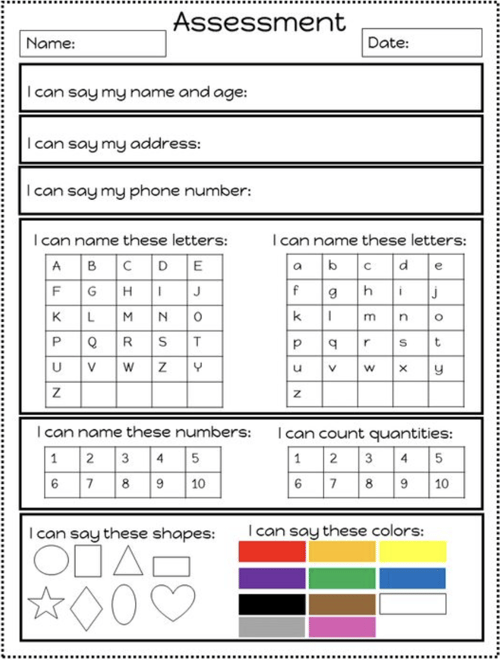
Photo credit: Pinterest
Social and emotional skills assessment template
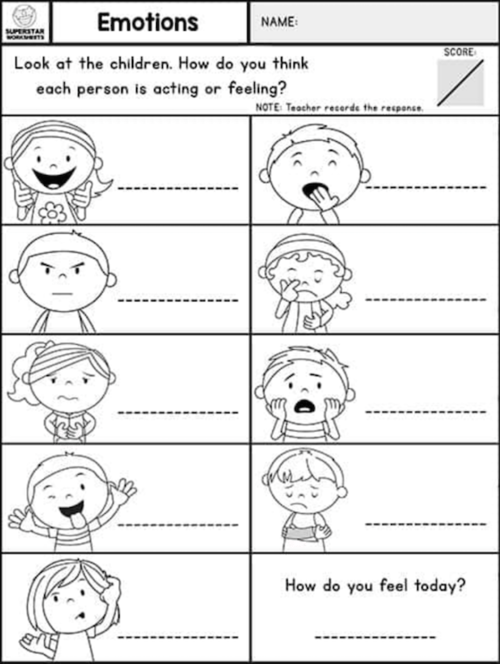
Photo credit: Superstar Worksheets
Frequently asked questions about preschool assessments
What types of assessments are used in preschools?
Preschools use both formal and informal assessments, as well as formative and summative methods. Formal assessments use standardized benchmarks to identify if a skill is present or emerging, while informal assessments rely on natural observations and work samples. Educators primarily use formative assessments during daily lessons to adapt teaching, as summative end-of-year assessments are often less developmentally appropriate for young children.
What is the difference between a developmental screening and an assessment?
A developmental screening is a brief, one-time check that flags whether a child may need a fuller evaluation, while an ongoing assessment tracks how a child is progressing over months and years. A screening answers “should we look into this further?” and an assessment answers “what is this child learning, and what should we teach next?” Programs typically use both: a screening shortly after enrollment, and ongoing assessment throughout the year.
What are the challenges involved in assessing preschoolers?
The main challenge in assessing preschoolers is their short attention span and daily behavioral variations. A child’s performance can change from one day to the next, making it difficult to get consistent results. Educators combat this by using quick, informal observations spread over multiple days.
How do I know if an assessment is formal?
A formal assessment is typically scored against a standardized benchmark or rubric. In a childcare program, these evaluations usually take place at the end of a learning period to see if a child meets specific developmental milestones. Unlike informal observations, formal assessments explicitly categorize a child’s skills as “present,” “emerging,” or “not yet emerging.”
How long should a preschool assessment take?
Most preschool assessments take between 10 and 15 minutes to complete. Because young children have limited attention spans, keeping the evaluation brief and stress-free ensures the most accurate observation of their natural abilities.
How often should preschool assessments be done?
Most preschool programs run a full assessment three times a year: a baseline in the fall, a progress check in the winter, and a final assessment in the spring. Informal observations happen continuously between those windows, which is what makes the three formal checkpoints meaningful.
Should families prepare their children for preschool assessments?
Families do not need to prepare their children for preschool assessments. These evaluations simply observe a child’s natural behavior, play, and daily interactions, so there is no need for studying or testing anxiety.
Who administers a preschool assessment?
The child’s own teacher usually administers a preschool assessment, because the assessment depends on knowing the child and observing them in a familiar setting. In smaller programs the director may do it, and in larger programs experienced educators often pair with newer staff until everyone can score consistently.
The bottom line
Preschool assessments play an integral role in shaping a child’s educational path. They provide valuable insights into a child’s development, highlighting strengths and identifying areas where additional support may be necessary. More importantly, these assessments foster an environment of personalized learning and growth, ensuring that educators recognize and nurture each child’s unique needs and abilities.
Brightwheel is an all-in-one childcare management software that saves time and simplifies operations for early education providers. From billing and parent communication to curriculum and admissions, it combines everything you need in one easy-to-use platform. Trusted by millions of educators and families and backed by a dedicated support team, brightwheel strengthens family connections and ensures seamless operations with reliable performance and robust security. With brightwheel, you’ll spend less time on admin, more time with children.