
What is a 1099 contractor?
A 1099 independent contractor is a self-employed worker hired for a specific task, who sets their own schedule and manages their own taxes.
Contractors often work for multiple clients. If you pay a contractor more than $600 in a calendar year, you issue them a Form 1099-NEC. A 1099 classification is better suited for specialized, short-term roles, while a W-2 classification works best when you need ongoing, integrated staff.
Common 1099 arrangements in childcare include:
- A music or yoga instructor who teaches a weekly class at your center and also works at other programs
- A curriculum consultant brought in to develop a new framework
- A photographer hired for a one-time family event

Payroll Template for Childcare Programs
A free template to simplify payroll tracking and management.
How does the IRS determine worker classification?
The IRS uses a three-part test focused on behavioral control, financial control, and the type of relationship to determine how much control your program has over the worker.
A useful rule of thumb: if a worker is present in your facility daily, follows your routines, and works with children under your supervision, they are almost certainly a W-2 employee, regardless of what any contract says.
The IRS evaluates:
- Behavioral control: Do you set the schedule, assign the classroom, and direct daily tasks? That points to employee status.
- Financial control: Do you provide materials and pay a regular wage? Contractors typically invest in their own tools and market their services independently.
- Type of relationship: Is there an ongoing working relationship with an expectation of continued work? Longevity and integration into your operations both matter.
Why does worker classification matter for childcare programs?
Worker classification matters because misclassifying employees as contractors can result in severe financial penalties, back taxes, and legal fees.
The use of contractors has grown significantly in recent years. According to Gusto data, small and mid-sized businesses using contractors increased 28% since 2020, and the contractor-to-employee ratio has nearly doubled from 1-in-10 to 1-in-5.¹ As more childcare programs bring in specialized instructors and flexible staff, the risk of misclassification grows with it.
The financial stakes are real. Misclassification can result in penalties up to 100% of the unpaid tax liability, plus back pay, retroactive benefits, and legal fees.²
What are the common gray areas in childcare staffing?
Common gray areas in childcare staffing include substitute teachers, enrichment instructors, and part-time staff, which all require careful review.
A few situations come up often and are worth addressing directly:
- Substitute teachers: Substitutes are among the most commonly misclassified workers in childcare. If your program calls a substitute in regularly, assigns them to specific classrooms, and expects them to follow your policies and ratios, they are functioning as employees. Paying them as contractors because the work is irregular does not satisfy the IRS test.
- Enrichment instructors: A music teacher or yoga instructor may genuinely qualify as a 1099 contractor, especially if they run their own business, set their own curriculum, and teach at multiple programs. Document their independent status carefully.
- Part-time staff: Hours alone do not determine classification. A part-time aide who works 10 hours a week under your supervision is still a W-2 employee.
What should you do if you are unsure about worker classification?
If you are uncertain about a specific worker, talk to a payroll professional, consult an HR advisor, or file Form SS-8 with the IRS to request a formal determination.
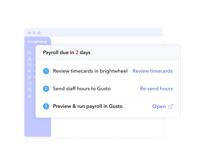
Do not guess. Having the right payroll system also helps. Brightwheel payroll, powered by Gusto, supports both W-2 employees and 1099 contractors in one place. Brightwheel provides automatic tax calculations, year-end W-2 and 1099-NEC filing, and built-in compliance support.
Frequently asked questions about W-2 vs 1099 childcare staff
Q: Can a childcare worker be both a W-2 employee and a 1099 contractor?
A: Yes, a worker can hold both classifications if they perform two completely distinct roles for your program. For example, a W-2 assistant teacher might act as a 1099 contractor if they operate an independent photography business and you hire them separately to take spring portraits.
Q: Does an independent contractor agreement protect my childcare program from IRS penalties?
A: No, a written contract does not override IRS regulations. If the worker's daily duties and level of supervision reflect an employee relationship, the IRS will classify them as a W-2 employee regardless of any signed agreements.
Q: What happens if I accidentally misclassify a childcare worker?
A: Accidentally misclassifying a worker as an independent contractor when they should be an employee can lead to significant consequences. If a government agency, like the Department of Labor or the IRS, determines you have misclassified someone, you may be required to pay back wages, overtime pay, and unpaid payroll taxes, along with penalties and interest. This can be a costly mistake, so it's important to correctly classify your staff from the start.
References
¹ U.S. Chamber of Commerce / CO, citing Gusto data: "How to Ensure Compliance for Independent Contractor Payments." uschamber.com/co, 2025. https://www.uschamber.com/co/co-brandstudio/gusto/ensuring-compliance-for-independent-contractor-payments
² IRS / Department of Labor guidance on worker misclassification penalties, as cited in: "2024 DOL Rule: Independent Contractor or Employee?" Gusto Resources. https://gusto.com/resources/articles/hr/hiring/dol-contractor-employee
This article is for educational purposes only and is not legal or tax advice. Worker classification rules vary by state and situation. Consult a qualified tax professional or HR advisor for guidance specific to your program.

.png "Introducing brightwheel payroll, powered by Gusto.")