
Childcare wage compliance involves adhering to federal, state, and local laws regarding minimum wage, overtime pay, and paid leave. Staying compliant requires childcare programs to constantly monitor and apply legislative updates to their payroll processes.
Running a childcare program means staying on top of a lot. Staff schedules, licensing requirements, ratio rules, curriculum planning, and somewhere in the mix, making sure your team is paid correctly and legally. That last part is more complicated than it sounds.
Wage and hour laws vary significantly from state to state. What is required of an employer in California is different from what is required in Texas, and both may be different from the rules in your city or county. And these laws do not hold still. According to the U.S. Department of Labor, states regularly update their minimum wage rates, with scheduled increases hitting multiple states each year, and mid-year adjustments common in others.¹ That means if your program is operating today the same way it operated a year ago, you may already be out of compliance without knowing it.
This article covers the key areas of state wage compliance that matter most to childcare programs, explains what can happen when something falls through the cracks, and shows you how to build a payroll process that keeps up automatically.
Why are state wage laws so complicated for childcare programs?
State wage laws are complicated because federal laws set a baseline, but individual states frequently enact stricter, overlapping regulations for wages, overtime, and leave.
The Fair Labor Standards Act (FLSA) establishes a federal minimum wage and sets the rules for overtime, record keeping, and child labor. But federal law is a floor, not a ceiling. States are free to go further — and most do.
Here is where it gets complicated for childcare directors:
- Minimum wage: Your state minimum wage may be higher than the federal rate, and it may change annually based on a cost-of-living formula. Some states also have different rates for different cities, counties, or employer sizes. Minimum wage is just one of many areas where you will find differences among states, with others including unemployment insurance taxable wage bases, pay transparency requirements, and child support withholding rules.²
- Overtime rules: Federal law requires overtime pay for non-exempt employees working more than 40 hours in a week. Some states require overtime after eight hours in a single day. If you have staff who sometimes work long shifts during cover days or staff meetings, daily overtime rules can matter.
- Paid leave: An increasing number of states now require employers to provide paid sick leave, paid family leave, or both. These programs often come with payroll contribution requirements that change year to year.
- Wage notices and record keeping: Many states require employers to provide written wage notices at hire, notify employees of any changes to their pay rate, and maintain detailed payroll records for specified periods. These are easy requirements to overlook and common audit triggers.
The overall volume of change is significant. Lawmakers pass roughly 15,000 new laws across all levels of government every year.³ Not all of them affect payroll, but enough do that staying current is a real operational challenge for any small employer, including childcare programs.

Payroll Template for Childcare Programs
A free template to simplify payroll tracking and management.
Wage and hour laws vary significantly from one state to another, which can make compliance a real challenge for childcare programs operating in different locations. To give you a clearer picture of this complexity, let’s look at how the minimum wage requirements differ across three major states: California, Texas, and New York. This comparison highlights why staying informed about your specific local regulations is so important.
|
State |
2026 minimum wage |
Effective date |
Notes |
|---|---|---|---|
|
California |
$16.90 per hour |
January 1, 2026 |
Statewide rate for all employers |
|
Texas |
$7.25 per hour |
Current in 2026 |
State follows the federal minimum wage |
|
New York |
$17.00 per hour |
January 1, 2026 |
Applies in New York City, Long Island, and Westchester County |
|
New York |
$16.00 per hour |
January 1, 2026 |
Applies in the rest of the state |
Sources: California Department of Industrial Relations; Texas Workforce Commission; New York State government
For childcare program operators, these differences can affect staffing costs, overtime planning, and time tracking workflows, so it’s important to review wage rules by state and location before processing payroll.
What happens if your childcare program falls behind on wage laws?
Failing to maintain childcare wage compliance can result in severe financial and legal consequences, including back pay, state penalties, and employee lawsuits.
Non-compliance with wage laws is not just a paperwork problem. Employers who fail to pay the correct minimum wage, calculate overtime incorrectly, or miss required paid leave contributions can face:
- Back pay owed to affected employees
- Penalties and interest from state labor agencies
- Civil lawsuits from employees
- Audits that dig into past payroll records
State labor agencies aggressively enforce these laws, particularly in industries with hourly workforces. Childcare programs, with large numbers of part-time and variable-schedule employees, are exactly the profile that auditors are trained to look for.
What are the highest-risk compliance areas for childcare programs?
The highest-risk compliance areas for childcare programs include minimum wage rate changes, overtime calculations for teachers, and paid sick leave tracking.
How do minimum wage and rate increases affect programs?
Every time your state or city raises its minimum wage, you need to update your pay rates and post updated labor law notices. Missing an effective date — even by one pay period — creates back pay liability. For programs with tight margins, the financial impact of a minimum wage audit can be significant.
Why is overtime a risk for teachers and aides?
Staff-to-child ratios mean you sometimes need people to stay late, come in early, or cover for absent colleagues. If those extra hours push a non-exempt employee over 40 hours in a week (or over your state's daily overtime threshold), you owe overtime pay. Manual timekeeping makes this easy to miss.
What do childcare programs need to know about paid sick leave?
As of 2026, more than 20 states and dozens of cities require employers to provide paid sick leave. If your state recently added this requirement, your payroll process needs to track accruals and ensure employees can access their leave correctly.
How do multi-site and multi-state rules work?
If you operate locations in more than one state, each location is governed by the laws of its own state. You cannot apply one state's rules uniformly across all sites.
How do brightwheel and Gusto help with childcare payroll?
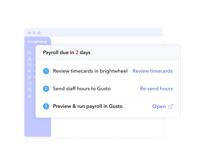
Brightwheel payroll, powered by Gusto, automates childcare wage compliance by calculating state-specific wages, overtime, and tax withholdings automatically.
Keeping up with state wage law changes manually is a full-time job. Gusto automatically calculates wages, overtime, and tax withholdings based on the rules for each state where your employees work. When minimum wage rates change, Gusto updates its tax tables. When state-required paid leave programs adjust their contribution rates, Gusto adjusts your deductions. Gusto files the majority of key federal and state tax forms automatically, including federal, state, and local filings⁴. This means your compliance obligations are handled every time you run payroll, not just at the end of the year.
For childcare programs, this means the people who watch minimum wage tables and paid leave rate changes for a living are doing that work on your behalf, in the background, every pay period.
References
¹ U.S. Department of Labor, Wage and Hour Division: "State Minimum Wage Laws." dol.gov. https://www.dol.gov/agencies/whd/minimum-wage/state
² HRMorning, "New State Minimum Wage Updates as 2026 Begins." hrmorning.com. https://www.hrmorning.com/news/minimum-wage-updates
³ Gusto / PR Newswire, "Gusto Acquires Mosey to Close the Compliance Gap for Small Businesses." April 2026. https://www.prnewswire.com/news-releases/gusto-acquires-mosey-to-close-the-compliance-gap-for-small-businesses-302737584.html
⁴ Gusto, "Payroll Tax Management and Compliance Software." gusto.com. https://gusto.com/product/payroll/tax-management
This article is for educational purposes only and is not legal or tax advice. Wage and hour laws vary by state and change frequently. Consult a qualified tax or labor law professional for guidance specific to your program.

.png "Introducing brightwheel payroll, powered by Gusto.")