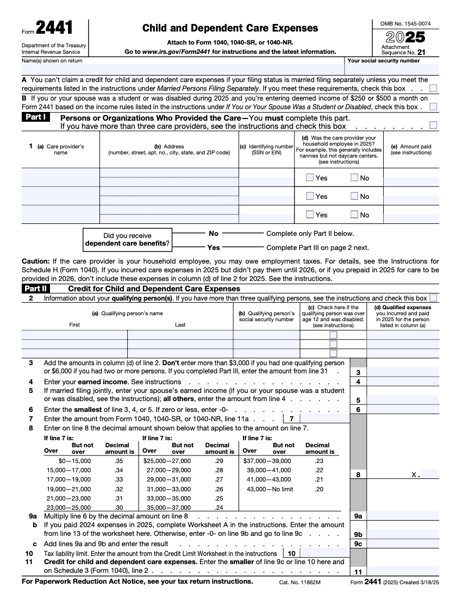
IRS Form 2441, Child and Dependent Care Expenses, is the form families attach to Form 1040 to claim the Child and Dependent Care Credit. For tax year 2026, the credit is worth 20% to 50% of up to $3,000 in work-related care expenses for one child or $6,000 for two or more, so the maximum credit is $1,500 or $3,000. Source: IRS, Child and Dependent Care Credit information
The families you serve will file their 2026 returns in early 2027, and many of them will turn to you for the details Form 2441 asks for. Knowing how the form works helps you answer their questions with confidence and hand them the right records the first time.
This guide covers what changed for 2026, who qualifies, which childcare expenses count, how dependent care FSAs fit in, and how your program can make tax season easier for families.
Brightwheel Webinar: Take Charge of Tax Season: Expert Tips from Brightwheel and Gusto
What is Form 2441?
IRS Form 2441 is how families calculate and claim the Child and Dependent Care Credit. Families attach it to Form 1040, 1040-SR, or 1040-NR. It has three parts: Part I lists each care provider, Part II figures the credit, and Part III reports any dependent care benefits from an employer.
The credit is nonrefundable. It can lower the tax a family owes to zero, but it doesn't create a refund on its own. Source: IRS, Child and Dependent Care Credit information
What are the eligibility requirements for Form 2441?
Families must meet every IRS test to claim the credit:
- Qualifying person: The care is for a dependent child under age 13, or for a spouse or dependent of any age who can't care for themselves and lived with the family for more than half the year.
- Earned income: The parent, and their spouse if filing jointly, had earned income during the year. A spouse who was a full-time student for at least 5 months, or who couldn't care for themselves, is treated as having earned income.
- Work-related expenses: The family paid for care so they could work or actively look for work.
- Eligible payee: The payments didn't go to the family's spouse, the child's parent, their own child under age 19, or anyone they can claim as a dependent.
- Filing status: Single, head of household, qualifying surviving spouse, or married filing jointly, unless an exception applies.
- Provider identification: The family lists each care provider's name, address, and taxpayer identification number on the form.
Source: IRS Publication 503
What changed for Form 2441 in 2026?
Starting with tax year 2026, the top credit rate rose from 35% to 50%, the income thresholds used to calculate the credit increased, and the dependent care FSA limit rose from $5,000 to $7,500. The $3,000 and $6,000 expense limits didn't change. These rules apply to returns families file in 2027.
| Tax year 2025 (filed in 2026) | Tax year 2026 (filed in 2027) | |
|---|---|---|
| Top credit rate | 35% | 50% |
| Rate floor | 20%, reached above $43,000 AGI | 20%, reached at higher incomes |
| Second phase-down | None | Above $75,000 AGI ($150,000 married filing jointly) |
| Expense limit | $3,000 for one child, $6,000 for two or more | Same |
| Maximum credit | $1,050 for one child, $2,100 for two or more | $1,500 for one child, $3,000 for two or more |
| Dependent care FSA exclusion | $5,000 ($2,500 married filing separately) | $7,500 ($3,750 married filing separately) |
Sources: IRS, Child and Dependent Care Credit information (2026); IRS Publication 503 (2025)
IRS Form 2441 and instructions
How do tax credits compare to tax deductions?
A tax credit lowers a family's tax bill directly, while a deduction lowers the income they're taxed on. Form 2441 provides a credit, so a $1,000 credit reduces taxes owed by exactly $1,000. A $1,000 deduction only reduces taxable income by $1,000, which saves far less.
Who qualifies for the Child and Dependent Care Credit in 2026?
Families qualify when they pay for care for a child under 13, or a dependent who can't care for themselves, so they can work or look for work, and they have earned income. There's no income cap. Higher incomes still get the credit, just at a lower percentage, which bottoms out at 20%. Source: IRS, Child and Dependent Care Credit information
How does income affect the credit in 2026?
The credit percentage is based on adjusted gross income (AGI):
- AGI of $15,000 or less: 50%
- AGI above $15,000: the rate gradually decreases to 35%
- AGI above $75,000 ($150,000 if married filing jointly): the rate gradually decreases again
- At any income: the rate never falls below 20%
For example, a family with two children in care, $6,000 in qualifying expenses, and an AGI of $14,000 can claim the full 50%, a $3,000 credit. Source: IRS, Child and Dependent Care Credit information
Which filing statuses qualify for Form 2441?
Families can claim the credit if they file as single, head of household, qualifying surviving spouse, or married filing jointly. Married couples generally must file jointly. A parent who files separately may still qualify if they lived apart from their spouse for the last 6 months of the year and meet the other IRS requirements. Source: IRS Publication 503
How can families check their eligibility?
Share this checklist with families before they file:
- They paid for care so they could work, look for work, or attend school full-time
- Their child was under 13 when care was provided, or their dependent can't care for themselves
- They have each provider's name, address, and taxpayer identification number (SSN or EIN)
- They kept records of what they paid throughout the year
- If married, both spouses worked, looked for work, or were full-time students during the care period

Common Tax Write-Offs for Childcare Businesses
Maximize your tax savings with this free guide.
Which childcare expenses qualify for Form 2441?
Expenses qualify when their main purpose is a child's care and well-being while the parents work. That includes preschool below kindergarten, before- and after-school care, and day camp. Kindergarten tuition, overnight camp, and tutoring don't count. Care at a center counts only if the center complies with state and local regulations. Source: IRS Publication 503
| Counts | Doesn't count |
|---|---|
| Preschool, nursery school, and pre-K below kindergarten | Kindergarten and higher-grade tuition |
| Before- and after-school care | Summer school and tutoring |
| Day camp, including specialty camps | Overnight camp |
| Transportation provided by the care provider | Transportation the family provides |
| Agency fees, deposits, and application fees required to get care | Forfeited deposits when no care was provided |
| Small meal or activity costs built into care that can't be split out | Separate charges for food, clothing, or entertainment |
| Care in the family's home by a nanny or babysitter while they work | Babysitting for a night out or other non-work time |
Source: IRS Publication 503
Families who pay a nanny or sitter to work in their home may be household employers with employment tax obligations. Source: IRS Publication 503 Families who aren't sure whether they qualify can use the IRS eligibility tool for the Child and Dependent Care Credit.
How does a dependent care FSA affect Form 2441?
Starting in 2026, families can exclude up to $7,500 a year in employer dependent care benefits, or $3,750 if married filing separately. Excluded benefits reduce the $3,000 or $6,000 expense limit for the credit, and the same dollars can't count twice. Families report these benefits in Part III of Form 2441. Source: IRS, Child and Dependent Care Credit information
A family that excludes $6,000 or more through an FSA has no expense limit left for the credit. Families with smaller FSA contributions can claim the credit on the remaining amount, up to the limit. Source: IRS Publication 503
Your year-end statements help families document both. Learn more about year-end tax statements and DCFSA documentation.
How can childcare programs help families with Form 2441?
You can help families file Form 2441 by sending accurate year-end tax statements, keeping clear payment records, and sharing your program's name, address, and tax ID early. Good records and timely communication make tax season smoother for families and cut down on last-minute requests to your front office.
For your own filing obligations, see the childcare provider taxes guide.
How can you streamline tax document preparation?
Brightwheel tracks family payments throughout the year and generates year-end tax statements for families. Each statement shows total care costs, your EIN, and payment details by date. You can also add a provider digital signature to the bottom of year-end statements. The signature ensures compliance for Canadian programs and is an optional enhancement for U.S. programs.
Why is it important to maintain accurate payment records?
Accurate records throughout the year prevent tax season headaches for you and for families. Childcare billing software keeps every payment documented as it happens, and automated childcare receipts confirm each transaction for families. When tax season arrives, you can follow these steps for how to generate year-end tax statements in brightwheel.
What provider information do families need for Form 2441?
Families need these details from every care provider:
- Name and address: Your program's legal business name and address
- Taxpayer identification number: An EIN for organizations, or an SSN or ITIN for individual providers. Tax-exempt organizations, such as a church or school, give their name and address only.
- Total paid: The amount each family paid you during the tax year
Some families will request this information on Form W-10, Dependent Care Provider's Identification and Certification. Responding promptly helps them claim the credit without delays. Source: IRS Topic 602
When should you communicate tax requirements to families?
Start in January. Send families a reminder that explains what Form 2441 requires, when year-end statements will be available, and how to download them from their parent account. Include a contact for questions. Clear, early communication builds trust, and 95% of admins and staff report that brightwheel improves communication with families.
What are common mistakes to avoid with Form 2441?
The most common Form 2441 mistakes are using the wrong year's rates, counting expenses that don't qualify, and leaving out provider details. You can help families avoid most of them by sharing the right records and pointing them to IRS guidance before they file.
- Using 2025 rates on a 2026 return: The top rate is now 50%, and the income thresholds changed.
- Counting expenses that don't qualify: Kindergarten tuition, overnight camp, and tutoring aren't care expenses.
- Counting FSA-paid expenses twice: Dollars reimbursed through a dependent care FSA can't also count toward the credit.
- Leaving out a provider's tax ID: If a provider won't share it, families need a due diligence statement.
- Paying an ineligible relative: Payments to a spouse, the child's parent, or the family's own child under 19 don't count.
- Going over the earned income limit: Qualifying expenses can't exceed the earned income of the lower-earning spouse.
Source: IRS Publication 503
Frequently asked questions about Form 2441
Does preschool tuition count for the Child and Dependent Care Credit?
Yes. Payments for a child in nursery school, preschool, or a similar program below kindergarten count as care expenses for Form 2441. Kindergarten and higher grades don't count, but before- and after-school care for a child in kindergarten or above can. Small costs for meals or activities that are part of the care and can't be separated from it can be included.
How much is the Child and Dependent Care Credit for 2026?
For tax year 2026, the credit is 20% to 50% of up to $3,000 in qualifying expenses for one child or $6,000 for two or more. Families with adjusted gross income of $15,000 or less get the full 50%, so the maximum credit is $1,500 for one child or $3,000 for two or more. The credit is nonrefundable.
Do payments to grandparents or other relatives qualify for Form 2441?
Payments to a relative, such as a grandparent, can qualify if that person isn't your dependent. You can't count payments to your spouse, to the child's parent, or to your own child who was under 19 at the end of the year. You still need the relative's name, address, and Social Security number to report on Form 2441.
Can I claim the credit if I use a dependent care FSA?
Yes, but not for the same dollars. Dependent care FSA money you exclude from income reduces the $3,000 or $6,000 expense limit for the credit. Starting in 2026, you can exclude up to $7,500 a year, or $3,750 if married filing separately, so a full FSA contribution can use up the entire limit. Report FSA benefits in Part III of Form 2441.
What if my childcare provider won't give me their tax ID number?
Report the information you have, such as the provider's name and address, and write "See Attached Statement" where the missing details go. Attach a note explaining that you asked for the information and the provider didn't give it. Requesting it with Form W-10 and keeping a copy shows due diligence, which lets you still claim the credit.
Can I claim the Child and Dependent Care Credit if I work from home?
Yes. Your work can be full-time or part-time, for an employer or your own business, and in or out of your home. What matters is that you pay for care so you, and your spouse if you file jointly, can work or actively look for work, and that you have earned income for the year.
Key takeaways for tax season 2027
For tax year 2026, the Child and Dependent Care Credit is worth up to 50% of qualifying care expenses, and dependent care FSAs can cover up to $7,500. Preschool, before- and after-school care, and day camp all count, while kindergarten tuition and overnight camp don't. Accurate year-end statements with your name, address, and tax ID help families claim the credit with confidence.
Programs that use childcare management software can generate these statements in a few clicks and spend less time answering tax-season questions.
This article is designed to provide general information regarding the subject matter covered. It is not intended to serve as legal, tax, or other financial advice related to individual situations. Because each individual's legal, tax, and financial situation differs, specific advice should be tailored to the particular circumstances. For this reason, you are advised to consult with your own attorney, CPA, and/or other advisors regarding your specific situation.