Even with a rigorous cleaning schedule at your childcare program, it is possible to spread germs like the flu, norovirus, and cold bacteria if not done correctly.
This article highlights common cleaning mistakes that many childcare programs make and offers simple solutions to fix them. With a few adjustments, you can ensure your space is truly clean, protecting the health of the children, families, and staff who depend on you.
Mistake #1: Confusing cleaning with disinfecting
One of the most significant misunderstandings in early education settings is the difference between cleaning and disinfecting. Many staff members believe that wiping a surface with a soapy cloth kills germs. In reality, scrubbing with soap and water removes visible dirt, grime, and some germs, but it does not kill viruses or bacteria.
The solution
Adopt a strict two-step process for every surface. First, clean the surface with soap and water to physically remove debris and sticky residue. If you skip this step, dirt can actually shield germs from chemicals. Second, disinfect the surface using an EPA-approved product. You must perform both steps to ensure the area is truly safe for children.
Mistake #2: Not allowing proper dwell time
Imagine a staff member spraying a changing table with disinfectant and immediately wiping it dry with a paper towel. This is perhaps the most common error in childcare cleaning. For a chemical disinfectant to effectively kill pathogens, it needs to remain wet on the surface for a specific amount of time. This is known as "dwell time" or "contact time." If you wipe it away too soon, you leave germs behind.
The solution
Read the fine print on your product labels. Most hospital-grade disinfectants require a surface to stay visibly wet for anywhere from three to ten minutes to be effective. Train your team to spray the surface, set a timer or move to another task, and only wipe the surface dry once the required time has passed.

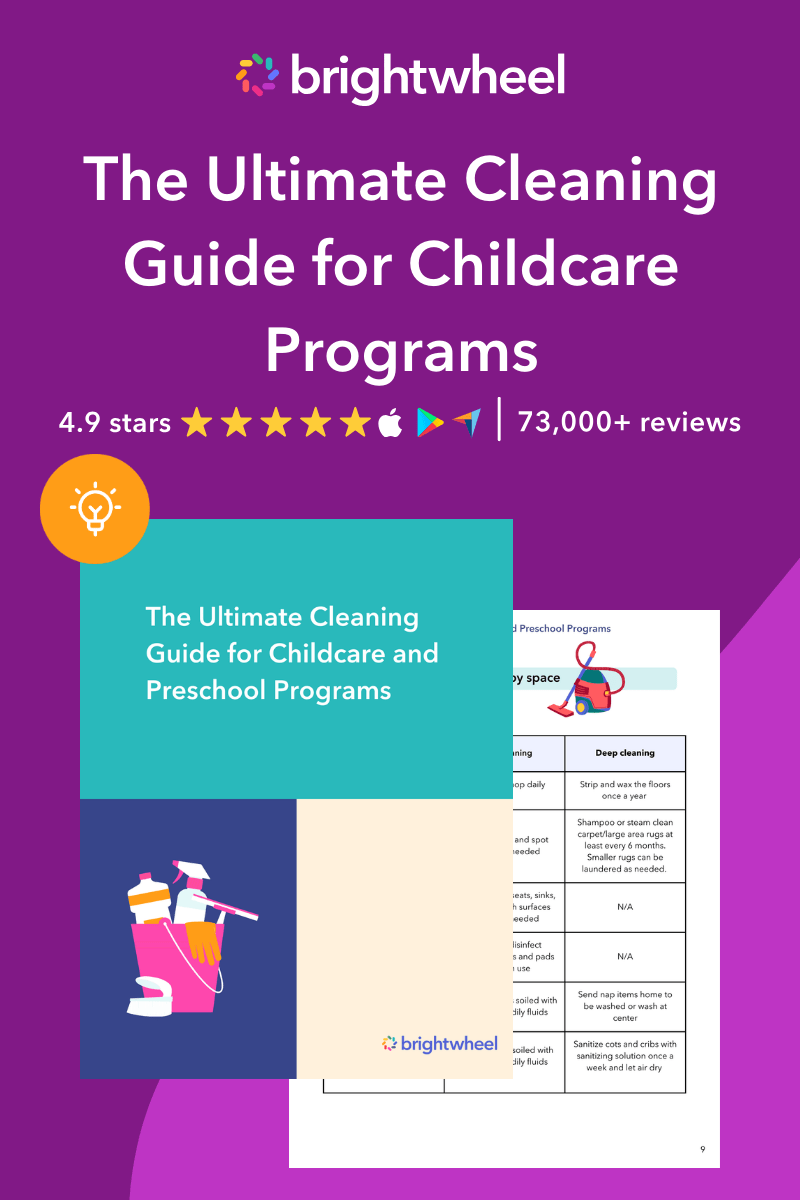
The Ultimate Cleaning Guide for Childcare Programs
Use this guide to create safe and healthy spaces for children, staff, and families.
Mistake #3: Using the same cloth for multiple surfaces
Cross-contamination occurs when germs from one area are transferred to another via cleaning tools. If a staff member wipes down a restroom counter and then uses the same cloth to wipe a table in the eating area, they spread fecal bacteria to a food surface. This happens frequently when programs lack a specific system for organizing cleaning supplies.
The solution
Implement a color-coded microfiber cloth system to make it visually obvious which cloth belongs where. For example, assign red cloths exclusively for high-risk areas like restrooms and diaper changing stations. Use green cloths for food preparation areas and kitchen surfaces, and blue cloths for general classroom surfaces like tables and chairs. This simple visual cue acts as a safeguard against spreading illness.
Mistake #4: Forgetting to clean high-touch points
It is natural to focus on the large surfaces that look dirty, such as floors, tables, and windows. However, germs congregate most densely on small, frequently touched surfaces that often go weeks without being disinfected. These "high-touch points" are major vectors for spreading illness among children and staff.
The solution
Create a specific checklist of high-touch points that staff must disinfect daily. Your list should include:
- Doorknobs and handles
- Light switches
- Cabinet handles
- Faucet handles
- Toilet flushers
- Sign-in tablets or keyboards
- Telephones
Mistake #5: Using expired or improperly mixed chemicals
Cleaning solutions, especially those you dilute from a concentrate, do not last forever. Once mixed with water, many solutions lose their effectiveness after a certain period. Additionally, "eyeballing" the ratio of water to chemical concentrate can result in a solution that is too weak to kill germs or too strong and potentially toxic for children.
The solution
Always follow the manufacturer's instructions for dilution ratios and use measuring tools—never guess. Once you mix a bottle, label it clearly with the contents and the date you mixed it. Check the product guidelines to see how long the diluted solution remains effective and discard it immediately once it expires.
Mistake #6: Neglecting soft surfaces and toys
Germs and allergens do not just live on hard surfaces like tile and plastic. Soft, porous items like dress-up clothes, stuffed animals, rugs, and cushions are magnets for dust mites, bacteria, and viruses. Because these items are harder to clean than a plastic table, they are often overlooked during daily routines.
The solution
Establish a regular schedule for laundering soft items. You should wash machine-washable toys, dress-up items, and fabrics weekly in the hottest water setting safe for the material. For rugs and cushions that cannot go in the washing machine, use a vacuum with a HEPA filter to trap allergens and use a fabric-safe sanitizing spray designated for childcare use.
Mistake #7: Relying on scent as a sign of clean
There is a common misconception that if a room smells like pine, lemon, or bleach, it is clean. However, fragrances are often added to cleaning products to mask odors rather than eliminate the source of the smell. Furthermore, synthetic fragrances often contain volatile organic compounds (VOCs) that can trigger allergies and asthma in sensitive children.
The solution
Choose fragrance-free products, preferably those that are EPA Safer Choice certified. A truly clean environment should not smell like chemicals or heavy perfumes; it shouldn't smell like anything at all. If you notice a persistent bad odor, focus your efforts on finding and eliminating the bacterial source rather than covering it up with air fresheners.
Mistake #8: Using a dirty mop or water
Mopping the floor is intended to remove dirt and germs, but if you use a dirty mop head or murky water, you are simply redistributing the grime from one part of the room to another. Bacteria thrive in damp, dirty mop heads, turning your cleaning tool into a contamination risk.
The solution
Adopt a two-bucket mopping system. Use one bucket for your fresh cleaning solution and a separate bucket for rinsing the dirty mop. Change the water as soon as it looks cloudy. Additionally, ensure you launder mop heads and dry them completely after every use. Never leave a wet mop head sitting in a bucket overnight.
Mistake #9: Overlooking air quality
You can scrub every surface in your facility, but if the air is stagnant and filled with dust, allergens, and airborne pathogens, the environment remains unhealthy. Poor indoor air quality is a significant contributor to respiratory issues and the spread of airborne illnesses in childcare programs.
The solution
Make air quality part of your cleaning strategy. Change your HVAC filters according to a strict monthly maintenance routine. When weather permits, open windows to ventilate the space and bring in fresh air. Regularly dust air vents and ceiling fans to prevent dust from circulating throughout the room.
Mistake #10: Lacking a consistent cleaning schedule
When cleaning tasks are left to memory or done "when there is time," they often fall through the cracks—especially on chaotic days. Without a clear plan, inconsistencies arise, and critical areas get missed. One staff member might clean the tables after every meal, while another might forget, leading to gaps in hygiene.
The solution
Documentation is key to accountability. Create and post detailed daily, weekly, and monthly cleaning checklists in every room. Assign specific tasks to specific staff members so everyone knows exactly what they are responsible for. A structured schedule guarantees that all areas, including those easily overlooked, receive the attention they need to keep your program safe.
A safer environment starts today
Avoiding common errors like confusing cleaning with disinfecting, ignoring dwell times, and overlooking high-touch points is crucial for maintaining a truly healthy childcare program. While the list of responsibilities is long, the safety of the children in your care makes it worth the effort.
By making these simple adjustments to your cleaning protocols, you can significantly reduce the spread of illness and create a safer space for everyone.