Most conversations about early childhood education software focus on the business side: billing, attendance, payroll, enrollment. But the same platform holds something harder to replace — the record of what each child is actually learning.
Are you still writing observations on sticky notes and transcribing them at the end of the day? Compiling progress reports by hand from a folder of work samples? Looking up your state's early learning standards every time you plan a lesson? Pen-and-paper documentation doesn't just cost time. It makes patterns invisible — a daily sheet tells you about today and nothing about the last four months.
This guide covers the teaching-and-learning side of early childhood education software: curriculum planning, observation, assessment, progress reporting, and standards alignment. For the operational features — enrollment, billing, attendance, and payroll — see the 9 essential features of childcare management software.
What does early childhood education software do for teaching and learning?
Early childhood education software supports teaching in four ways: it holds lesson plans and curriculum activities teachers can reach from the classroom, lets them record observations and work samples as they happen rather than at the end of the day, accumulates that documentation into each child's developmental profile over time, and turns it into progress reports for families and licensing. The real difference from paper is that you can see a child's whole year in one place, instead of one day at a time.
Curriculum planning and lesson support
Lesson planning is essential to good teaching outcomes and it is reliably one of the most time-consuming things your educators do. Software helps in two distinct ways, and it's worth separating them when you evaluate a platform.
The first is holding your own curriculum: a place to build, store, reuse, and adapt lesson plans, so a teacher isn't rebuilding a theme week from scratch each year and a substitute can pick up a plan without a handover conversation. Ask whether plans are accessible from a phone or tablet in the classroom, not just from the office desktop — planning tools that only work at a computer tend to go unused.
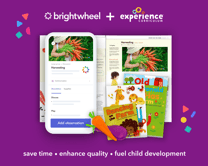
The second is supplying a curriculum. A tool like brightwheel's Experience Curriculum is designed to save time during lesson and curriculum planning by providing the content itself. It includes digital lessons along with hands-on learning materials that are straightforward for educators to implement in the classroom. Instead of looking up your state's early learning standards each time you plan, they're preloaded. It also contains DRDP learning frameworks and Montessori progress indicators.
The distinction matters because the two options carry different costs and commitments. A platform that holds your curriculum is usually part of the base software; a platform that supplies one, particularly with physical materials, is typically priced separately.

Daily Lesson Plan Template
A free, printable template for creating lesson plans.
Child observation and documentation
Informal assessment — observation and samples of a child's work — is where most of what you know about a child actually comes from. The problem with paper isn't the observing. It's everything after.
A teacher notices something at 10:15am, writes it on a sticky note, and transcribes it at 5pm if the day allows. Often the day doesn't allow, and the observation is either lost or reduced to something vaguer than what she saw. Software closes that gap by letting her capture the note, photo, or short video in the moment, on a device already in her hand, tagged to the child it concerns.
What to look for beyond simple capture:
- Tagging to a developmental domain, not just to a child, so observations can be pulled together by area of development rather than only chronologically
- Photo and video storage that accumulates into developmental portfolios rather than sitting in a camera roll
- Controlled visibility — teachers, administrators, and families should each see what's appropriate to them, and you should be able to see which is which before you publish anything to a family
Documentation that's easy to capture and easy to share changes what a family conference looks like. Everyone with a role in a child's development has access to the same record, rather than the teacher reconstructing four months from memory.
Assessment and developmental tracking
Early childhood education requires both formal and informal assessment, and the two work differently. Most programs need both, so the practical question when comparing platforms is whether a tool handles one well and the other as an afterthought.
| Formal assessment | Informal assessment | |
|---|---|---|
| What it is | Structured, scheduled evaluation against a defined framework or standard | Ongoing observation of a child during normal activity |
| When it happens | At set intervals — entry, mid-year, year-end | Continuously, throughout the day |
| What it produces | Rated or scored results, comparable across children and across time | Anecdotal notes, photos, work samples |
| How software helps | Holds the framework, prompts you at the right intervals, calculates and stores results | Lets a teacher capture a note or photo in seconds, from the classroom, tagged to a child and a domain |
| What it's good for | Licensing, funding requirements, demonstrating program quality | Understanding an individual child, informing tomorrow's lesson, family conferences |
The two feed each other. Observation notes and work samples collected informally are the evidence that makes formal assessment — portfolios and progress report cards — reflect the child rather than the assessment window.
This is the part paper can't do. When every observation and milestone lands on the same child's profile, you can step back and see how that child has grown over months — not just what happened today. It's a different question from the one a daily sheet answers, and it's usually where a concern first shows up. Or where a quiet strength does.

Progress reporting for families and licensing
Progress reports serve two audiences that want different things, and this is worth checking carefully because platforms tend to be built for one.
Families want to understand their child. That means narrative, photos, specific moments — something that reads like a person wrote it about their child, not a scorecard.
Licensors and funders want structure. That means results recorded against a defined framework, at defined intervals, in a format they'll accept, with documentation behind it if they ask.
Software that handles reporting well can generate both from the same underlying documentation, rather than making your staff assemble each one separately. Instead of manually compiling everything, the platform can produce data-rich reports that include photos and videos alongside the assessment record.
When you evaluate this, ask to see a finished report of each type — not the report builder. A builder always looks capable; the output is what your families and your licensor will actually receive.
Aligning to your state's early learning standards
This is the least-discussed feature in the category and one of the most useful, because early learning standards are set state by state. A platform built around one state's framework, or around no framework at all, leaves your teachers doing the mapping by hand — which is the work software was supposed to remove.
Preloaded standards mean a teacher planning a lesson can see which standards it addresses without leaving the plan, and an administrator preparing for licensing can show coverage without reconstructing it.
Questions worth asking any vendor:
- Are my state's early learning standards preloaded, and how current are they?
- Which assessment frameworks are supported — DRDP, Montessori progress indicators, others?
- Can lesson plans be tagged to standards, so coverage is visible while planning rather than after?
- If my state updates its standards, who updates the platform, and how quickly?
Support here varies more between vendors than almost any other feature, and it's rarely covered in a demo unless you ask. It's worth asking early.
Frequently asked questions
Q: Can early childhood education software replace a written curriculum?
A: It depends on the platform. Some hold a curriculum you already have — a place to build, store, and reuse your own lesson plans. Others supply one, including the lesson content and sometimes physical materials. Those are different products at different prices, so clarify which one you're being shown. A platform that only holds plans won't give you a curriculum, and a supplied curriculum may or may not let you adapt it to your program.
Q: Does childcare software support DRDP or my state's early learning standards?
A: Support varies substantially by vendor and by state, so this needs to be a direct question rather than an assumption. Brightwheel's Experience Curriculum has state early learning standards preloaded and includes DRDP learning frameworks and Montessori progress indicators. When comparing platforms, ask specifically about your state and about who maintains the standards when they're updated.
Q: What's the difference between formal and informal assessment in preschool?
A: Informal assessment is ongoing observation of a child during normal activity — anecdotal notes, photos, work samples. Formal assessment is structured evaluation at set intervals against a defined framework, producing results that are comparable across children and over time. Informal assessment tells you about this child right now; formal assessment is what licensing and funders generally require. Most programs need both, and the informal documentation is the evidence that makes formal assessment meaningful.
Q: Can teachers record observations from a phone or tablet in the classroom?
A: On most modern platforms, yes, and it's worth confirming because it determines whether observation documentation actually happens. Capturing a note or photo in the moment, tagged to the child, is the difference between a record of what a teacher saw and a reconstruction at the end of a long day.
Q: How does software help with progress reports for families?
A: It pulls the observations, photos, and assessment results already recorded through the term into a report, rather than requiring staff to compile each one by hand. The practical benefit is that reports draw on documentation gathered across months instead of whatever is recent enough to remember — and families receive something specific about their child rather than a generic summary.
Supporting the teaching side of your program
Early childhood education software won't address every challenge of running a childcare business, but the teaching-and-learning half of it is often the more overlooked. Automating billing saves you hours; documenting development well changes what you know about the children in your care and what you can show their families.
If you're comparing platforms, start by asking to see one finished progress report and one week of lesson plans. Those two things will tell you more about how a system actually works in a classroom than any feature list.
Learn more about brightwheel's Experience Curriculum, or see what's included in brightwheel Premium and what's quoted separately.