Child check-in software replaces paper sign-in sheets with a digital record of who dropped off each child, who picked them up, and exactly when. For most programs the hard part isn't deciding to go digital — it's choosing a check-in method that fits your facility and your families, knowing which questions actually separate one platform from another, and switching without turning drop-off into a bottleneck for a week.
This guide covers all three. If you want a direct product overview instead, see brightwheel's childcare attendance tracking and check-in features.
What is child check-in software?
Child check-in software records child and staff arrival and departure times digitally, usually through a tablet at the entrance, a parent's smartphone, or a staff device in the classroom. It timestamps each entry automatically, stores the record so it can't be lost or water-damaged, and — depending on the platform — feeds that data into attendance reports, room ratio monitoring, tuition billing, and staff payroll.
The core difference from a paper sign-in sheet is that the record is structured. A paper sheet is a signature in a column. A digital check-in is a data point the rest of your operation can use, and an auditable record a licensing agent can accept.
What are the different types of child check-in?
Most programs assume they need to pick one method. In practice you'll likely use two or three, because families and days vary.
|
Method |
How it works |
Speed at drop-off |
Shared surface? |
Works without smartphone? |
Best for |
|---|---|---|---|---|---|
|
QR code scan |
Parent scans a code with their phone, or scans a printed code |
Fastest |
No |
No |
Busy centers with one main entrance |
|
4-digit PIN on a kiosk |
Parent taps their code into a tablet at the door |
Fast |
Yes |
Yes |
Mixed-tech families; the universal fallback |
|
Parent mobile app |
Parent checks in from their own device |
Fastest |
No |
No |
Curbside and carline drop-off |
|
Staff-assisted |
A teacher marks children in on a classroom device |
Moderate |
No |
Yes |
Infant rooms, bus arrivals, field trips, forgotten phones |
|
Paper sign-in sheet |
Handwritten name and time |
Slowest |
Yes |
Yes |
Emergency backup only |
Two things worth settling before you choose.
Be precise about what "contactless" means to you. Brightwheel counts 4-digit code entry as contactless check-in, because the family initiates it themselves rather than handing over a clipboard — families can check in by entering the code, or by scanning a QR code and entering the code. If what you need is no shared surface at all, the QR or app-based scan is the option to ask vendors about specifically. Many programs run the code as the universal fallback and the scan as the default.
You will always need a staff-assisted path. Phones die, families forget codes, and substitutes arrive untrained. Any platform you evaluate should let a staff member complete a check-in manually, and let an administrator correct the record afterward.
How to set up kiosk-based check-in
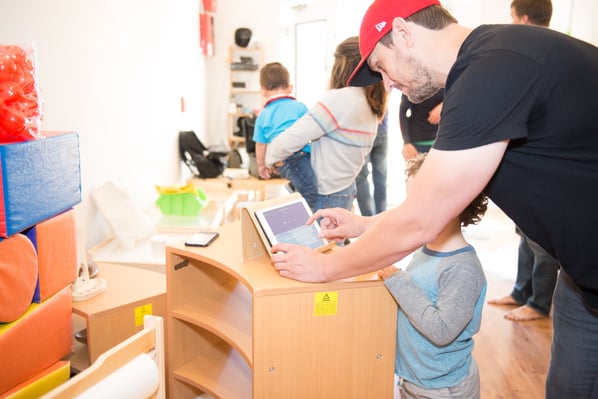
A check-in kiosk is a tablet at your entrance, locked to the check-in screen so families can't navigate elsewhere in the app. It's the most common center setup, and it's what makes digital check-in work for families without a smartphone.
What you need:
- A tablet. An iPad or Android tablet with a front-facing camera handles both PIN entry and QR scanning. Most programs use one device per entrance.
- A stand or mount, plus power. A kiosk that dies at 4pm creates exactly the pickup problem you were solving. Mount it near an outlet.
- Strong WiFi at the door. Entryways are often the weakest signal point in a building — far from the router, behind masonry. Test the actual spot before launch, not the office.
- Screen lock enabled. Confirm your platform can lock the device to the check-in screen. Without it, an unattended tablet is an open door into your roster and other families' information.
With brightwheel, administrators can set up a kiosk device where parents check in with a 4-digit code, and can turn the Quick Scan contactless setting on or off at any time from the School Profile on the app or under School Settings on the web. If a family arrives without a phone, staff can check the child in instead.
How many kiosks? One per entrance families actually use. If you have a main door and a side door for the after-school program, you need two — or you need to close one door at drop-off. If a large share of your families arrive inside the same short window, a second device at the main entrance is usually cheaper than the line it prevents. Watch your first week and add one if a queue forms.
How does mobile check-in work?
Mobile check-in lets a parent complete the check-in from their own phone rather than a shared device. In practice that usually means the parent's app displays or scans a QR code the kiosk reads, or the parent checks in directly in the app while on site.
It's the fastest option at drop-off and the one families notice most, particularly for carline arrival. One constraint is worth understanding because it's common across the category: mobile check-in is usually tied to physical presence. Some platforms enforce this with a location check that only completes within a set distance of the site; others require the parent's code to be scanned by a device at the door. Ask any vendor how presence is enforced, and ask your licensing agency whether that method satisfies your state.
Where mobile check-in genuinely pays off is the multi-child family. With brightwheel, a parent can check in all of their children at once with a single scan or code rather than repeating the process per child.
Check-in for multi-site programs
Operating more than one location raises a question single sites never face: can you see attendance across all your centers in one place, or do you log into each separately?
This is the most common gap between what a platform demos and what a multi-site director needs. Before you sign, ask:
- Can I see current attendance for every site on one screen, without switching accounts?
- Can I pull a single attendance report spanning all locations for a date range?
- Do room ratio alerts roll up to a regional view, or only fire locally?
- Can I standardize check-in settings — signature requirements, health screens, QR on or off — across sites, or does each director configure their own?
- Is multi-site reporting included, or is it a different product tier?
That last question matters more than it sounds. Some platforms sell multi-site capability as a separate enterprise product, with its own documentation and its own price. The version you demoed may not be the version you'd buy.
Do digital signatures satisfy state licensing requirements?
This is the question that stalls the most check-in decisions, and it deserves a direct answer: it depends on your state, and you should confirm with your licensing agency before you switch.
Many states require a parent or guardian signature at drop-off and pickup. Some accept an electronic signature; some specify what the record must contain; some require the record identify which authorized adult signed, not merely that a signature occurred. That last detail is where digital systems differ meaningfully — a check-in completed by a staff member on a classroom device doesn't necessarily capture a guardian's identity the way a kiosk signature does.
Four questions to bring to your licensing consultant, then to any vendor:
- Does my state accept electronic signatures for daily attendance records?
- Must the record identify the specific individual who dropped off and picked up?
- How long must attendance records be retained, and in what format?
- If a record is corrected after the fact, must the correction be documented?
On that fourth point: Brightwheel administrators can export a spreadsheet of attendance audit logs showing who edited a record, what changed, and the date and time of the edit — and email it directly to a state licensing agent. Brightwheel also supports digital signatures and customizable health screens where states require them, and administrators can identify missing signatures and request them from the student's guardian after the fact.
Signature rules specifically are best confirmed with your licensing agency directly, since they change and vary in ways no vendor page can keep current.
What to ask before you buy
Nearly every established platform in this category supports the core check-in methods — QR, PIN, kiosk, staff-assisted, digital signatures, health screens, ratio alerts. Comparing feature checklists tells you very little, because almost everyone checks almost every box.
What actually differs is how those features are packaged, what happens when something breaks, and whether the data goes anywhere useful. Six questions that surface real differences faster than a feature list:
- Is every feature you just showed me included at the price you just quoted? This is the single most useful question you can ask. Platforms commonly gate individual capabilities — a kiosk mode, staff time tracking, ratio alerts, multi-site reporting — behind a higher tier, a separate module, or a different product entirely. "Does it do kiosk check-in" and "is kiosk check-in included at this price" are different questions, and only the second one affects your budget. Brightwheel quotes an all-inclusive monthly fee with access to all features, so the answer doesn't change as you use more.
- What happens when the internet goes down at 7:45am? Is there an offline path, a printable backup sheet, or neither?
- Can an administrator correct an attendance record, and is that correction logged? Licensing agents ask about this.
- How does a family without a smartphone check in? If the answer is "staff do it for them," confirm that satisfies your state's signature rule.
- Does attendance data flow into billing and payroll, or do I re-enter it? Re-entry is where the time savings disappear.
- What's your actual support response time during morning drop-off? Not the SLA — the real number.

Free Guide for Selecting Childcare Management Software
Download a free guide to simplify your decision-making process and help you choose the best childcare software for your program.
How to roll out check-in software without a chaotic first week
The software rarely fails. The rollout does. Six things that separate a smooth switch from a rough one.
Set up the physical space before you train anyone
Decide device placement, confirm WiFi strength at that exact spot, and mount the hardware. Training staff on a device that isn't where it will live doesn't transfer.
Train staff two weeks out, not two days out
Run training inside an existing staff meeting rather than adding a session. Give people a practice environment and let them make mistakes before real families are waiting. Record a short screen capture for new hires and substitutes — this is the artifact still paying off six months later.
Tell families three times, through three channels
An email, a sign at the door, and a newsletter mention. Announce several weeks ahead, then remind as the date approaches. Include a screenshot of what they'll see. Families who arrive surprised are the ones who create a line.
Staff the door for the first three mornings
Assign one person whose only job during drop-off is helping families through the new flow. This single decision prevents more bad first impressions than any amount of documentation.
Run paper in parallel for one week
Keep a clipboard at the door as backup for the first week. It costs nothing, and it removes the failure mode where a technical hiccup leaves you with no attendance record for a day that turns out to matter.
Collect feedback after week one
Ask staff and a handful of families what was confusing. Most rollout problems are settings problems — a signature requirement that's on when it shouldn't be, a health screen that's too long — and they're quick to fix once you know.
Is check-in software worth the cost?
The return shows up in three places, and only some of it is measurable on day one.
-
Immediate and measurable: reporting time. If you currently tally paper sheets by hand to produce attendance reports for licensing or to calculate tuition, that work largely disappears. This is usually the clearest before-and-after.
-
Immediate but harder to measure: accuracy and audit readiness. Automatic timestamps reduce the transcription errors paper sheets accumulate, and a digital record turns a missing signature into something you can find and chase rather than discover during a licensing visit. Programs that bill for early drop-off or late pickup also tend to capture charges that manual tracking misses.
-
Ongoing: administrative load. The savings compound when check-in data feeds the rest of your operation rather than sitting in a silo — attendance driving billing, staff hours driving payroll, room counts driving ratio alerts. Brightwheel publishes that its all-in-one app saves programs up to 20 hours per month on administrative tasks.
Pricing models vary — some platforms price per child, some per site, some by enrollment capacity, and some gate individual features by tier. Brightwheel bundles billing, family communication, attendance, lesson planning, and reporting into one monthly fee, and most attendance features work on the free version. Request pricing to see what applies to your program.
Frequently asked questions about child check-in software
How does contactless check-in work?
Families initiate the check-in themselves rather than touching a shared device. With brightwheel, a parent either enters a 4-digit code or scans a QR code and enters their code. Programs can also enable digital signatures, health screens, and QR codes to make check-in faster and to stay compliant with licensing requirements.
What if a parent forgets their phone or doesn't have a smartphone?
Staff can check the child in. Brightwheel also lets administrators set up a kiosk device where parents use a 4-digit code without needing a smartphone. If a signature is missed, administrators can view attendance records, identify the missing signature, and request it from the student's guardian.
Can a parent check in multiple children at once?
Yes. With brightwheel, parents check in all of their children with a single scan or code rather than repeating the process for each child.
Can attendance records be edited after the fact?
Yes. Brightwheel administrators can correct, add, edit, or delete attendance records, and can export a spreadsheet of attendance audit logs detailing who edited records, what changed, and the date and time of each edit — which can be emailed directly to state licensing agents.
Does check-in software track staff attendance too?
Yes. Brightwheel tracks staff attendance alongside children's check-ins and check-outs. Staff sign in digitally, and total hours worked can be exported and synced with payroll.
Can check-in be turned off if it isn't working for our program?
Yes. Any brightwheel administrator can enable or disable the contactless Quick Scan setting at any time from the School Profile on the app, or under School Settings on the web.
Is child check-in software secure?
Ask any vendor for specifics rather than accepting "bank-level security." Brightwheel's check-in data is protected by data encryption, cloud storage on Amazon Web Services, and TX-RAMP–certified security controls, with PCI Level 1 compliance for payment processing so no confidential banking information is stored on brightwheel. Brightwheel publishes 99.9% uptime with 24×7 monitoring by a dedicated in-house team, and supports two-factor authentication and strict password requirements on accounts. Administrators control what each staff member can see using staff-level permissions. See brightwheel's security and safety overview for details.
Can we send health screening questions before families arrive?
Yes. Brightwheel administrators can allow parent-level contacts to submit a health screen questionnaire from home, with statements customizable based on CDC and local jurisdiction requirements.
Is child check-in software free?
Most of brightwheel's attendance features can be used with the free version of brightwheel, with brightwheel Premium available for unlimited access to all features. Contact the team for pricing.
How long does it take to switch from paper check-in?
Plan two to three weeks: one week for setup and staff training, one week of family communication ahead of launch, and one week running paper in parallel as backup. Brightwheel's team imports student rosters and tuition rates so programs have their information from day one, and guided training is available through brightwheel Academy.
Next steps
If you're evaluating check-in specifically, the fastest path is to see it running: brightwheel's attendance tracking and check-in features walks through sign-in and out, attendance reports, ratio compliance, and billing integration.
If you're earlier in the process and comparing whole platforms, how to choose childcare management software covers the broader evaluation.
Brightwheel is rated 4.9 across more than 160,000 reviews, and its support team answers live chat in less than one minute.