Enrolling a new family at your childcare program is an exciting time, but it often begins with a mountain of paperwork. For many families, the initial experience involves juggling a stack of forms, while administrators spend valuable time tracking down missing signatures and incomplete information. This "paperwork fatigue" can create a challenging first impression and add unnecessary stress to the onboarding process for everyone involved.
A disorganized or lengthy intake process can lead to incomplete files, increase your administrative workload, and start your relationship with new families on a complicated note. There is a simpler, more effective way to manage this crucial step. Bundling your consent forms is a straightforward strategy to streamline onboarding.
This article will provide actionable tips on how to group forms logically to improve the family experience and ensure all necessary documentation is collected efficiently from day one.
The benefits of bundling consent forms
Organizing your forms into logical packets offers significant advantages for both families and your program. It transforms a potentially chaotic process into a structured, user-friendly experience.
For families:
- Reduces overwhelm: Presenting a few organized packets of information makes the process feel much less daunting than being handed a thick, random stack of papers.
- Saves time: Families can complete related information all at once, which reduces repetitive data entry and makes the task quicker to complete.
- Improves clarity: Grouping forms by purpose helps families understand exactly what they are signing and why each document is important for their child's safety and care.
For childcare providers:
- Increases completion rates: A simplified and logical process leads to fewer missed forms and a much higher rate of on-time, complete returns.
- Saves administrative time: You’ll spend less time chasing down missing signatures or clarifying incomplete information, freeing up your team to focus on the children.
- Enhances professionalism: A well-organized onboarding system demonstrates your program’s efficiency and commitment to detail, building trust with families from the very beginning.

Childcare Consent and Release Forms
Use this free set of fillable PDF templates to obtain the required approvals and permissions from families.
How to group your forms into logical bundles
The key to successful bundling is to group forms by their function. This approach helps families focus on one area of information at a time. Here is a proven way to categorize your forms into three distinct packets.
Bundle 1: The health and safety packet
This bundle is the most critical, as it contains all the information needed to ensure a child’s health and well-being while in your care. Grouping these forms together emphasizes their importance and ensures you have all emergency-related permissions on file before a child’s first day.
Forms to include:
- Child medical consent form: Grants permission to seek medical treatment in an emergency.
- Medication administration form: Provides explicit authorization and instructions for administering medication.
- Allergy information and action plan: Details known allergies and the specific response plan required.
- Permission to apply sunscreen/topical creams: Authorizes staff to apply over-the-counter products like sunscreen or insect repellent.
- Diaper cream authorization form: A specific permission slip for applying diaper creams, often required by licensing.
Bundle 2: The permissions and releases packet
This packet combines forms that grant your program permission for various activities and releases. These often require families to make specific choices, so separating them from the essential health forms allows them to give these items careful consideration.
Forms to include:
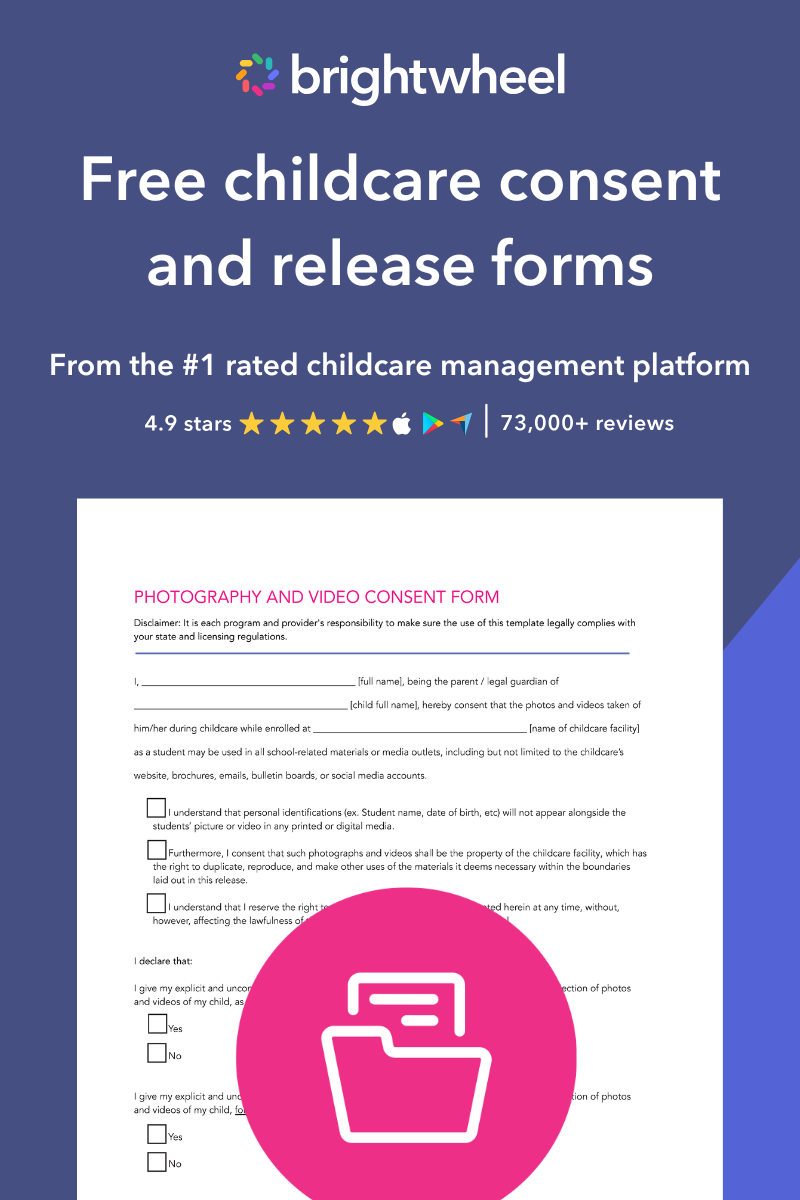
- Photography and video consent form: Outlines if and how a child’s image may be used for internal purposes, family communication, or external marketing.
- Parent consent for field trips: Gives permission for off-site activities, whether it’s a general release for local walks or a form for a specific trip.
- Transportation plan and consent: Details the methods of transportation your program uses and secures consent for the child to be transported.
- Directory information release: Allows you to share contact information with other families in the child’s class, if applicable.
Bundle 3: The enrollment and policies packet
This bundle includes the contractual agreements and policy acknowledgments that form the basis of the relationship between the family and your program. These documents outline mutual responsibilities and expectations.
Forms to include:
- Enrollment agreement/contract: The formal agreement detailing enrollment terms, hours, and start date.
- Parent handbook acknowledgment form: A signed confirmation that families have received, read, and agree to abide by your program’s policies and procedures.
- Tuition and payment policy agreement: Outlines the payment schedule, fees, and accepted payment methods.
- Authorized pick-up list: A secure list of all individuals authorized to pick up the child, including contact information.
Best practices for presenting bundled forms
How you present the bundled forms is just as important as how you organize them. The goal is to make the process as smooth as possible.
Use a checklist
Provide a simple cover sheet for each bundle that lists all the included forms. This acts as a table of contents and helps families track their progress. They can check off each form as they complete it, ensuring nothing is missed.
Go digital
Using a childcare management system to handle forms electronically offers immense benefits. Digital forms can be sent, signed, and stored in one secure place. Many systems can also pre-populate information, like a child’s name and date of birth, across multiple documents to save families time. You can also easily track incomplete forms and send automated reminders, which significantly cuts down on administrative follow-up.
Provide clear instructions
Whether you use paper or digital forms, include a brief explanation at the top of each bundle. For example, a note that says, "This packet contains all necessary health and emergency forms for your child," helps orient families and clarifies the purpose of the information they are providing.
Schedule a paperwork session
For families who prefer paper or may need extra assistance, consider offering a dedicated time to complete the forms. Setting aside 15-20 minutes during a tour or orientation allows a staff member to be present to answer questions, which can ensure accuracy and 100% completion on the spot.
A better onboarding experience starts here
A well-organized intake process does more than just save time—it sets the stage for a positive and trusting relationship with new families. By bundling your consent forms into logical, easy-to-manage packets, you reduce overwhelm for families and increase efficiency for your administrative team. This simple change demonstrates your program's professionalism and commitment to providing a great experience from the very first interaction.